Downloadliste
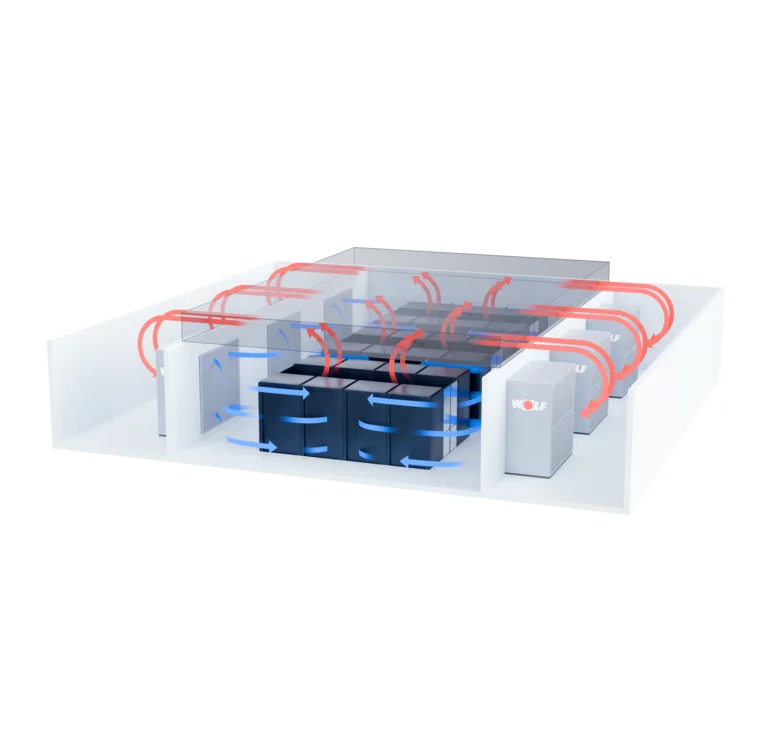
Hybrid cooling: essential for future-proof data centres
The power density of individual racks will continue to rise rapidly, and with it their size, weight and the waste heat they generate. Reference architectures for modern high-performance computers combine both liquid and air cooling technologies in hybrid cooling: liquid cooling is used specifically for direct component cooling of particularly high-density server components, whilst residual heat is dissipated via the air.
With liquid cooling, the majority of the heat loads from data centre racks are dissipated via direct-to-chip or rear-door systems. Nevertheless, unavoidable residual heat loads remain in the white space, which must still be dissipated via the air. This residual heat consists of waste heat from components such as power converters, memory modules and network cards, as well as general enclosure and ambient losses. Its proportion typically ranges from around 10 to 30%, depending on the architecture, coverage and system design.

Hybrid cooling architectures for high power densities with different IT systems
Hybrid cooling architectures are therefore becoming increasingly important for large data centres, particularly in the hyperscale sector. They make it possible to combine high power densities with a variety of IT systems whilst meeting requirements for availability and energy efficiency. For colocation facilities too, air-cooling concepts installed alongside liquid cooling offer advantages, as they can cool mixed IT infrastructures in particular according to demand.
In the field of air cooling, the cooling of white space via CRAH or CRAC systems is currently widespread. These systems each cool specific zones. In addition to their disadvantage of taking up floor space in the white space and requiring a complex and expensive raised floor construction, there are also higher structural requirements as increasingly powerful racks become heavier and therefore generate high point loads on the raised floor.
The Challenge of Voltage Drop
For CRAH or CRAC systems, a further challenge only becomes apparent upon closer inspection: even during power cuts lasting just a few minutes, the airspace between the racks heats up so rapidly within seconds that the servers (have to) shut down, necessitating a time-consuming restart later on.
These limitations do not apply when using Fanwall systems or Fan Wall Units (FWUs). They therefore offer a flexible, modularly scalable and energy-efficient solution with inherent redundancy, both for retrofitting existing data centres with liquid cooling and for new builds.
Whilst liquid cooling acts selectively on the installed rack, Fanwall systems regulate the airspace of the entire white space area, thereby avoiding local hotspots or temperature gradients. Fanwall systems thus exert a stabilising effect on the thermal conditions in the white space.
Demand-based control
Particularly noteworthy is the high control response speed of the fans, which helps to stabilise the overall system, especially in modular environments with variable load profiles. The demand-based control of the fans also enables a significant reduction in energy consumption.
A fan wall is also characterised by a high level of operational reliability, as a fault-related failure of individual components has only a marginal effect on the overall system (inherent redundancy).
In combination with containment concepts such as Hot Aisle Containment (HAC), the separation of cold supply air and warm exhaust air can be optimised. This helps to reduce thermal losses.
Precise design is essential
Precise design of the airflow is essential to ensure consistent cooling performance. Flow simulations play a key role in achieving this. Integration into existing infrastructure can also be complex, particularly in retrofit projects, but the long-term efficiency gains more than make up for the planning effort.
In the event of short-term power cuts, the air volume present in the white space offers limited thermal inertia (thermal ride-through). It partially buffers short-term load fluctuations or transitional phases during faults and prevents servers from having to shut down due to overheating. This effect depends heavily on the power density and the specific system design and must therefore be taken into account at the planning stage.
Separation of Service and IT
Another key advantage of Fanwall systems stems from their installation and use of space. As a Fanwall system is installed along the wall, there is no need to place air conditioning units within the IT area. This creates additional space for IT infrastructure and simplifies the data centre’s architecture.
This separation of the technical and white space zones not only reduces the risk of disruptions during operation but also enhances the overall security of the data centre. At the same time, it improves maintainability, as components remain accessible during operation and interventions can be carried out in a targeted manner with minimal impact on the IT infrastructure.
Maintenance work can also be carried out whilst the system is running. The WOLF Fanwall DCA solution is particularly noteworthy, as the special fans are integrated into the service doors, meaning that maintenance and service work is carried out exclusively from the technical corridor. This prevents service personnel from having to work in the sensitive IT area.
Furthermore, this Fanwall solution is characterised by an exceptionally shallow depth and a small footprint, as well as around 8% lower energy consumption compared to standard solutions.
Conclusion:
In summary, it can be said that liquid cooling will play a central role in cooling high-density IT systems, but cannot completely replace air cooling. Instead, a hybrid approach is becoming increasingly established, in which both technologies are combined to capitalise on their respective strengths. Air cooling remains an important component of modern data centre concepts, particularly for residual heat, room conditioning and system integration.
Careful planning at an early stage, involving all trades and stakeholders, ensures that the most efficient solution is always implemented.
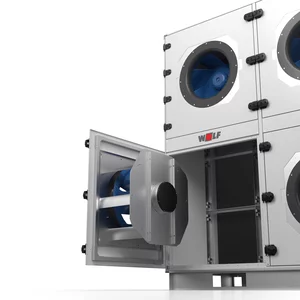
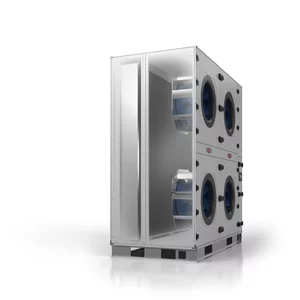
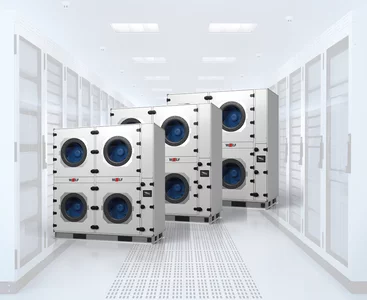
Fanwall systems
A fanwall system utilises an entire wall surface as a single, continuous active cooling unit. It consists of a combination of heat exchangers and a large number of modularly arranged fans, which can be controlled independently of one another. The extensive layout of a fan wall generates uniform airflow throughout the entire white space (rather than ‘merely’ cooling individual zones). They offer consistent temperature control, high controllability and system-level redundancy.
Depending on the building conditions and the manufacturer, fan wall systems also make it possible to separate the maintenance and IT areas from one another.
Author:
Geert Paelinck
Business Development Manager for Data Centres, WOLF Mainburg
More information about WOLF Fanwall DCA is available at: Data Centre Fanwall DCA | WOLF Heating, Air Handling & Ventilation