Downloadliste
Leaks in rotary heat exchangers (RHE) – inherent to the system, but manageable
From an energy efficiency perspective, rotary heat exchangers represent the optimal solution for HVAC units. Regenerative heat recovery not only enables savings in thermal energy, but also the recovery of moisture and the associated latent heat energy. Peter Hofstetter, training specialist for HVAC units at WOLF, explains how system-related leaks can be managed in order to fully exploit the energy benefits of regenerative heat recovery.
Depending on the design of a rotary heat exchanger, active humidification in winter and/or active dehumidification in summer can often be dispensed with:
• Condensation rotor for the transfer of sensible heat with humidity recovery at low outdoor air temperatures
• Enthalpy rotor with hygroscopic coating for increased humidity recovery – dehumidification in summer mode and rehumidification in winter mode
• Sorption rotor with highly hygroscopic coating for optimum humidity recovery – dehumidification in summer mode and rehumidification in winter mode

Further advantages of rotary heat exchangers include their compact design, the fact that no condensate drainage is required, ease of cleaning, and lower pressure drop compared to a plate heat exchanger. For air flow rates of > approx. 10,000 m³/h, there is also a cost advantage in terms of capital expenditure.
In regenerative heat recovery using a rotary heat exchanger, the two air streams – for example, from exhaust air and outside air – come into contact with the surface of the heat exchanger alternately, due to the design. Due to the mechanical nature of the system, leaks cannot be ruled out, which may lead to undesirable transfer of substances and odours.
Observe hygiene requirements
The hygiene requirements and assessment criteria for air quality suggest that rotary heat exchangers should only be used if no odours or pollutants can be transferred from the exhaust air into the supply air. In case of doubt, leaks should be treated as recirculated air.
The quality of the exhaust air or the exhaust air category plays a decisive role in this.
Exhaust air of the best category, EHA1, from residential, classroom or office spaces can be reused as recirculated air at a rate of 50% with standard ISOePM10 exhaust air filtration, in accordance with VDI 6022/3. Exhaust air of category EHA2, i.e. air with low ‘emissions from the premises’, such as from dining rooms, hotel rooms or changing rooms, must be treated prior to reuse in such a way that it can be classified as EHA1.
Depending on the air quality requirements, exhaust air purification can be complex and causes pressure losses, thereby leading to additional energy consumption. For this reason, leak-free, recuperative processes such as plate heat exchangers are often preferred.
To ensure that the energy benefits of rotary heat exchangers are not lost in sensitive systems, it is important to control system-related leaks. The following leaks must be taken into account:
• At the centre-web seal where the exhaust and supply air streams meet
• Due to co-rotating air within the storage mass of the rotary heat exchanger
• Along the circumference of the rotary heat exchanger
(Figure 2)
Prevent leaks in the centre web seal
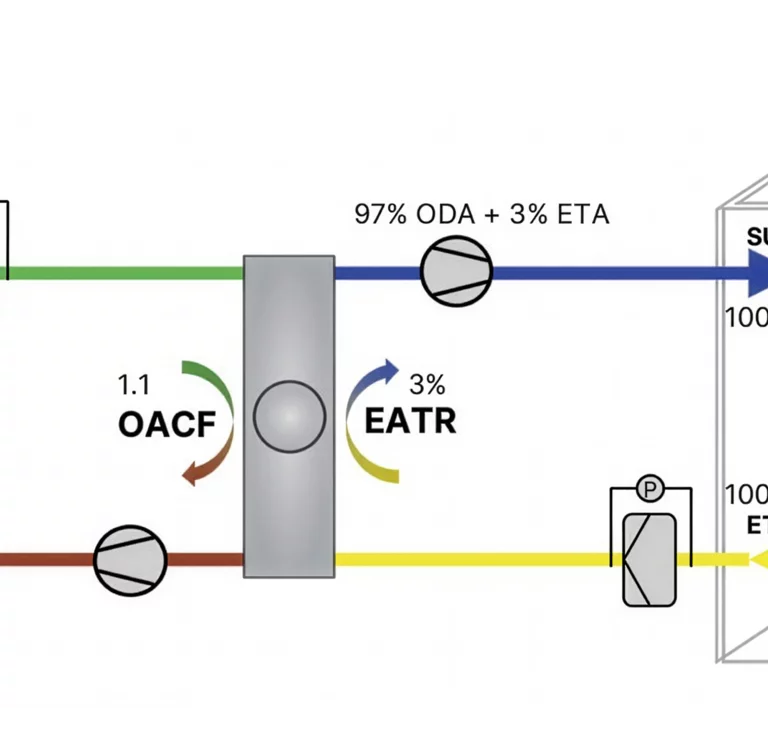
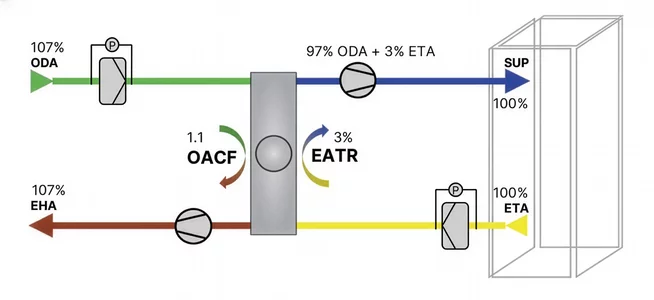
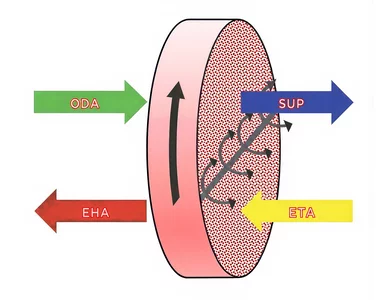
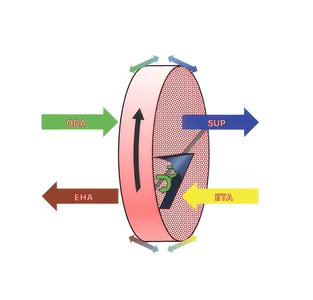
The design of the centre-bar seal is primarily responsible for the actual air volumes available and is described by the parameters EATR (Extraction Air Transfer Ratio) and OACF (Outdoor Air Correction Factor).
Leakage from the outdoor air (ODA) to the exhaust air side (EHA) reduces the available supply air volume. The correction factor OACF (e.g. 1.1) in the example means that 10% of the outdoor air flows to the exhaust air side via the centre-bar seal. The EATR value (e.g. 3%) indicates how much exhaust air is transferred to the supply air via the centre-bar seal.
In the example, the supply air (SUP) consists of 97% outdoor air (ODA) and 3% exhaust air (ETA). To ensure a balanced supply and exhaust air volume, the exhaust fan must deliver 7% more air than calculated for the nominal air volume.
(Figure 3)
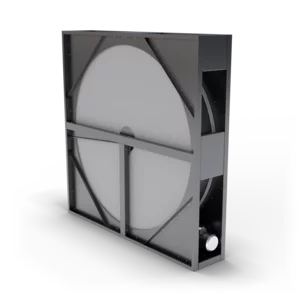
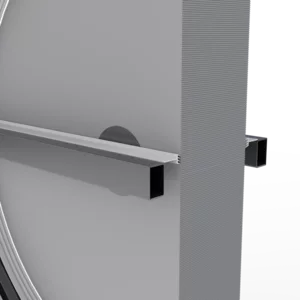
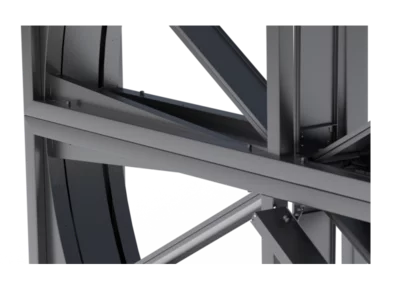
This relationship highlights the importance of the centre seal functioning optimally in order to reduce recirculation and ensure balanced supply and exhaust air volumes. WOLF Air Handling favours a multi-lip seal, which offers equally good sealing performance, a long service life and low friction.
(Figure 4 & 5)
“Co-rotation” can transport exhaust air to the outside
In addition to the undesirable recirculation of air caused by the EATR, attention must also be paid to the transfer of co-rotating exhaust air into the supply air. For physical reasons, the volume of air transferred in this way depends on the air volume within the storage mass and the rotational speed.
An example: With 10,000 m³/h of supply and exhaust air, an air volume of 0.2 m³ in the rotary heat exchanger and a typical rotor speed of 12 rpm, the additional recirculation rate is:
12 rpm * 60 min/h * 0.2 m³ / 10,000 m³/h = 1.44%.
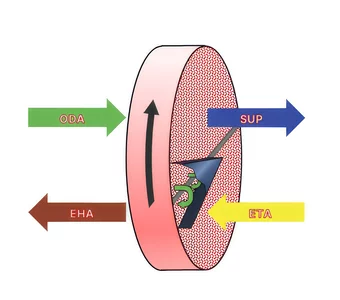
A purge chamber or purge sector can remedy this by briefly purging the rotor mass in the transition zone between the exhaust air and the outside air with fresh outside air.
(Figure 6)
When the fans are correctly arranged, purge chambers are extremely effective and reduce the proportion of co-rotating exhaust air to less than 0.5%. However, this prevention of exhaust air carry-over is accompanied by a slight increase in the OAC factor and marginally reduced heat recovery values.
To ensure the optimal functioning of a purge chamber, the pressures, the arrangement of the fans, as well as the rotor speed and purge angle must be correctly coordinated.
The correct arrangement of the fans
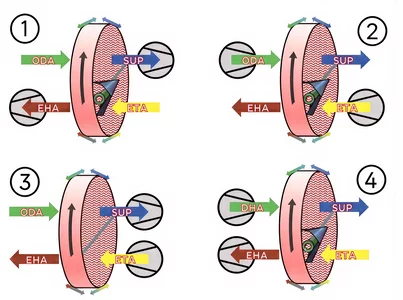
In many cases, the building’s geometry – or rather the available space – influences the layout of the components in the ventilation system. However, there are clear preferred configurations for operation with a rotary heat exchanger.
(Figure 7)
Evaluation of the various options for fan arrangement in typical applications:
1) Recommended arrangement to minimise leakage and reduce fan energy consumption
2) Possible – but high OACF values – correction of outdoor air fan recommended
3) Recommended arrangement if recirculation mode is permitted and planned – purge chamber not possible or necessary
4) Possible – but very high OACF values – correction via outdoor air fan necessary
(Figure 8)
Significance of the circumference of a rotary heat exchanger:
A pressure equilibrium is established across all four air flows (ODA, SUP, ETA and EHA) in the cavity surrounding the rotary heat exchanger. Depending on the fan configuration, any leaks that occur can have a negative impact on the OACF and EATR parameters, as well as on the heat recovery capacity. Measurements on existing systems often reveal leakage rates of over 10%, resulting in effects on air volumes and efficiency losses that are difficult to predict.
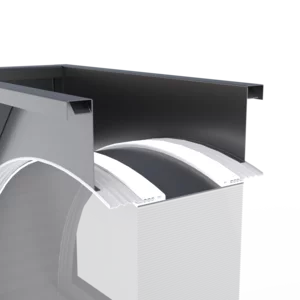
Effective sealing around the perimeter of the storage mass is therefore essential. A circumferential labyrinth seal delivers excellent results, capable of reducing leakage to less than 2 %.
(Figure 9)
Conclusion:
Rotary heat exchangers (RHE) offer significant energy benefits for HVAC units, particularly through regenerative heat recovery, which recovers both thermal energy and moisture. This can reduce the need for active humidification in winter and dehumidification in summer. Various designs, such as condensation, enthalpy and sorption rotors, offer specific advantages in terms of moisture recovery and efficiency.
Despite their advantages, leaks in RHTs are inherent to the system and can lead to undesirable transfer of substances and odours. The quality of the exhaust air and hygiene requirements are therefore crucial for the use of HRV. Leakage can be minimised through appropriate measures such as effective centre-bar seals and purge chambers. The correct arrangement of the fans also plays an important role in reducing leakage and ensuring a balanced supply and exhaust air flow.
In sensitive facilities, it is important to control system-related leakage in order to fully exploit the energy benefits of RWT. A circumferential labyrinth seal can reduce leakage to less than 2%, thereby improving efficiency and air quality.
Author:
Peter Hofstetter
Training Officer for HVAC Equipment, WOLF Mainburg
More information about WOLF ventilation technology is available at: https://www.wolf.eu/en-de/professional/ahu-products